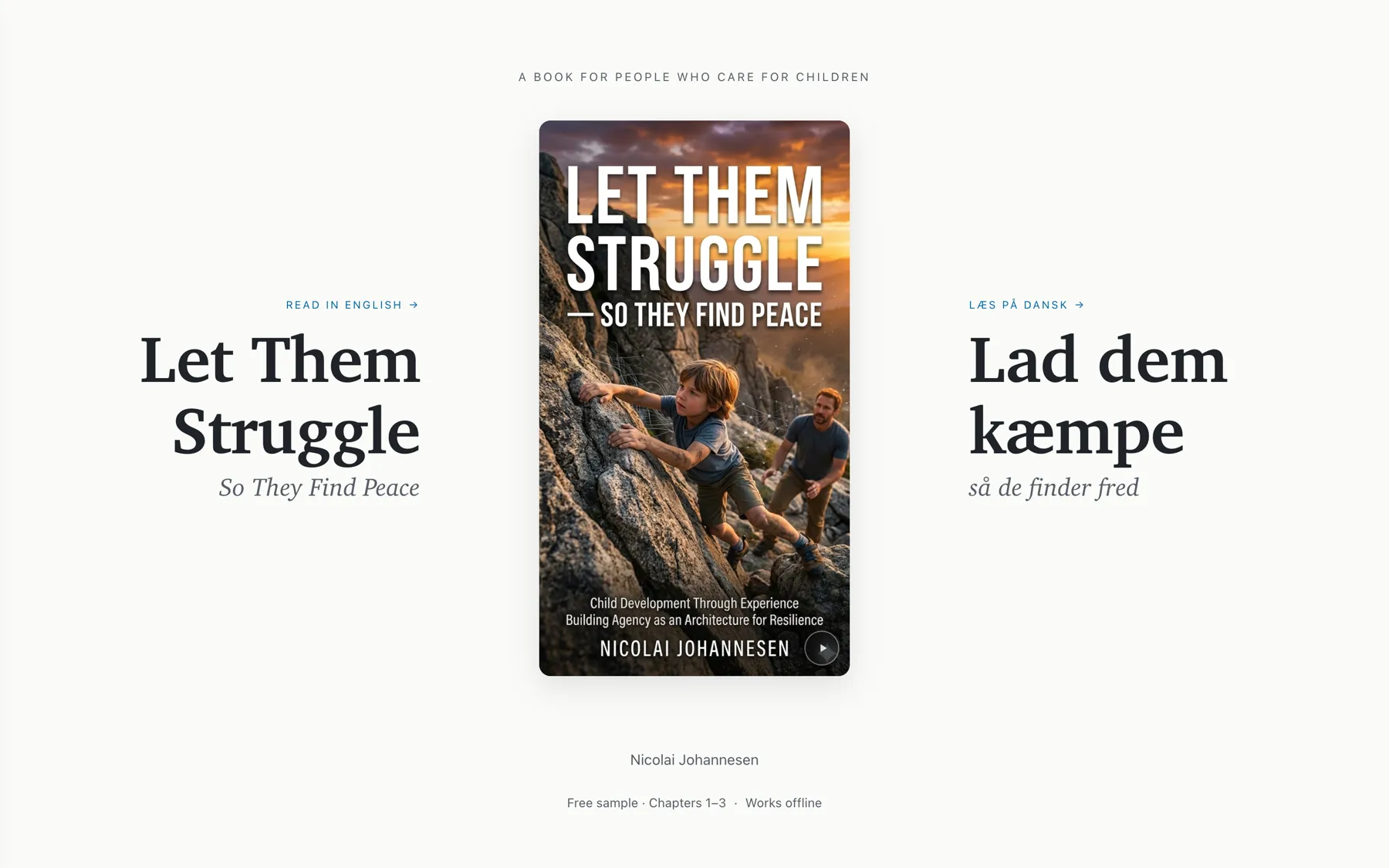
Read Part I free — English & Danish, side by side →
The goal of parenting is not protection from difficulty. It is architecture — building a nervous system that handles unavoidable difficulty when the parent is no longer there.
What the book argues
Agency — the learned experience that effort produces results — is the primary developmental gift a parent can give, and the path to peace: the settled capability of someone who knows difficulty has shape and has moved through it before. The brain is physically plastic; it reshapes through experience, year by year. An overprotected child arrives at adulthood without the neural architecture to handle what life inevitably requires.
Give parents — and anyone close to children — a different perspective on the goal: build the architecture that protects the child enough to learn at the edge of their capability — without protecting them so much that they never reach it.
The book's spine is an upward spiral: struggle the child can influence, run as a repeating loop, compounds over many turns into capability, earned confidence, and — given purpose — peace. The progression climbs rather than circles; a break at any turn produces a predictable failure mode. Purpose — the sense that one's actions matter in the world, agency at lifespan scale — is the last turn before peace. The longitudinal evidence (Hill and Turiano's 14-year follow-up, Martela et al.'s 23-year study) finds purpose a stronger predictor of longevity than life satisfaction. It is not found; it crystallizes from hundreds of agency cycles accumulated over childhood.
What makes this different
The parenting shelf already has two failure modes. The authoritarian books apply external pressure; the outcome is compliance without capability. The anecdote-driven books motivate without mechanism; the reader finishes moved but without a framework they can run. This book is mechanism-first.
The framing is resistance training. Every adult accepts the gym logic: too little resistance produces atrophy; too much produces injury; the right resistance with progressive overload produces growth. The spotter does not lift — they step in only to prevent damage. Nobody argues this for muscles. The book asks why the same logic gets abandoned for cognitive, emotional, and social development, where the adult-life stakes are higher.
The intellectual foundation is Vygotsky's zone of proximal development — growth happens at the edge of current capability with support just within reach — grounded in contemporary developmental neuroscience: Seligman and Maier on learned helplessness, the Gallagher meta-analysis (51 studies, 11,000+ participants) on perceived control as a transdiagnostic vulnerability factor across all anxiety categories, Anna Machin and Robin Dunbar on the father input as evolutionarily distinct from the mother's. The post-Haidt reader has the diagnosis (overprotection produces fragile children) but not the working framework. This book is the framework.
Four domains of hard things
Not all challenge develops the same thing. The book argues that hard things operate across four domains — physical, cognitive, emotional, and social — each with its own pain signal, growth curve, and characteristic avoidance pattern. Most parents already accept physical challenge: sports, climbing, the scraped knee. The resistance is systematic in the other three domains, especially emotional and social.
Yet emotional and social challenge carry the highest adult-life impact of all four. The ability to grieve without being destroyed, repair relationships after rupture, hold authority under pressure, negotiate rather than capitulate — these are the capabilities that determine quality of life far more than physical or cognitive performance. And they can only be built the same way: encounter, discomfort, processing, iteration. A child who has had rich exposure across all four domains has built architecture that transfers to genuinely novel adult situations.
Current state and what's next
Research is complete and the structure is locked — a 17-chapter upward spiral across four parts. Part I — three chapters, The Reflex, Peace Is Built, and Compounding — is written and readable now, a bilingual reader with English and Danish side by side, free, as the opening sample. Read it →
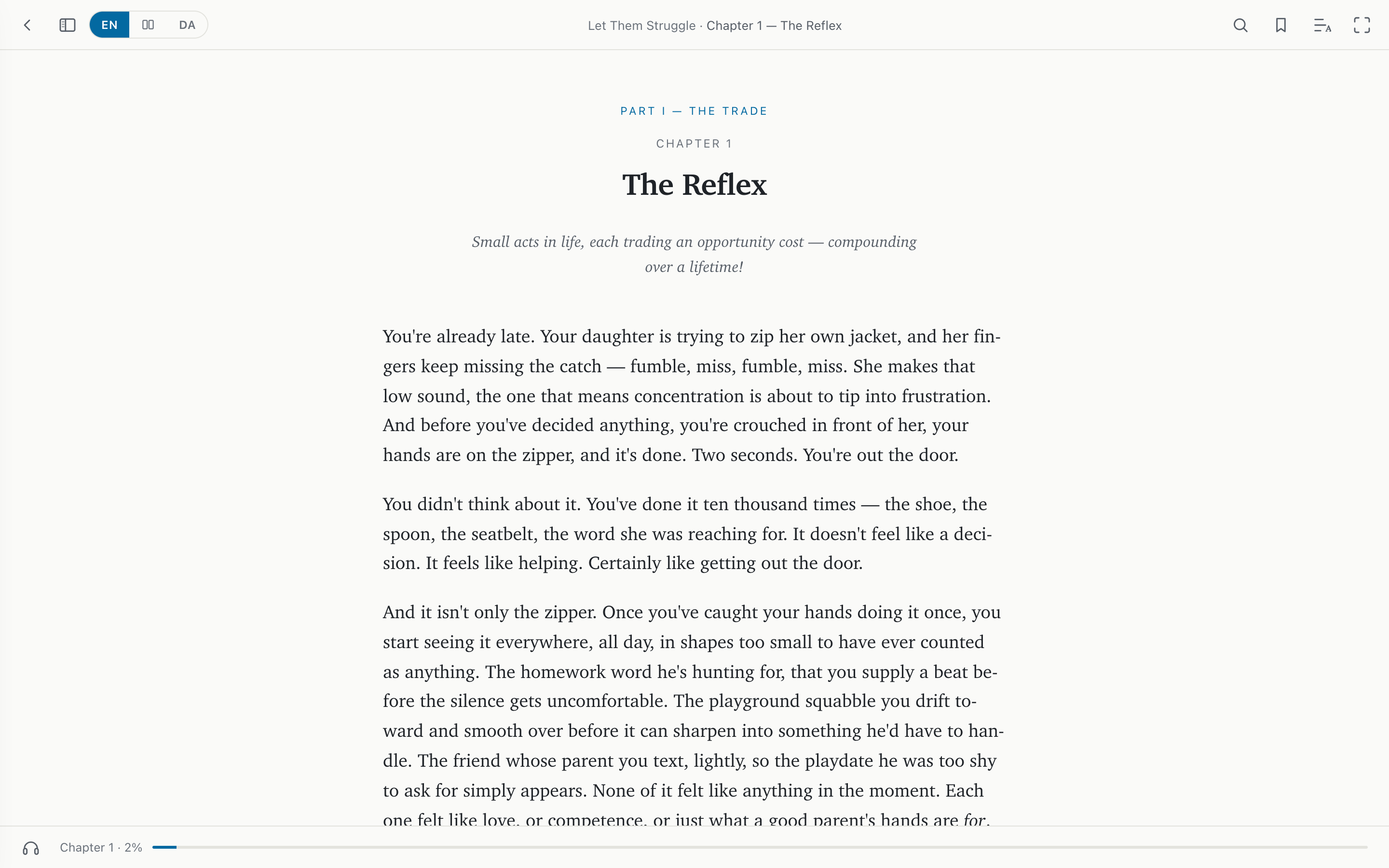
Chapter 1, The Reflex, in the reader — tap a language to start, read English or Danish, your place kept as you go.
The reader is v2.4.6. It loads instantly — the cover, both languages, and the title paint the moment it opens, and the book streams in behind them, so a slow connection never leaves you on a blank screen (and a failed load offers a clear retry rather than nothing). It ships three typeface options (Serif, Sans, Dyslexia-friendly), a text-size stepper, and three reading-density presets — Compact, Comfortable, Spacious. The settings panel is grouped into four sections: Appearance, Reading, Customize, and Actions; line spacing, paragraph spacing, and the blue-light filter sit behind a Customize disclosure so the panel stays uncluttered by default. Themed scrollbars track the active colour theme. The Night theme is softened. Read-aloud keeps your place when you leave the app, scrolls to follow the spoken line, puts play controls on the lock screen, and lets you tap a line to jump there; and the book is one tap to share. In the side-by-side view, the column you tap chooses the language you hear — English or Danish — and that choice carries as you read on; tapping a chapter headline starts the reading from there. The bilingual title page sets both languages in clean facing columns, and the layout is built to take a third language when one comes. It is a calm reading instrument, not a framework.
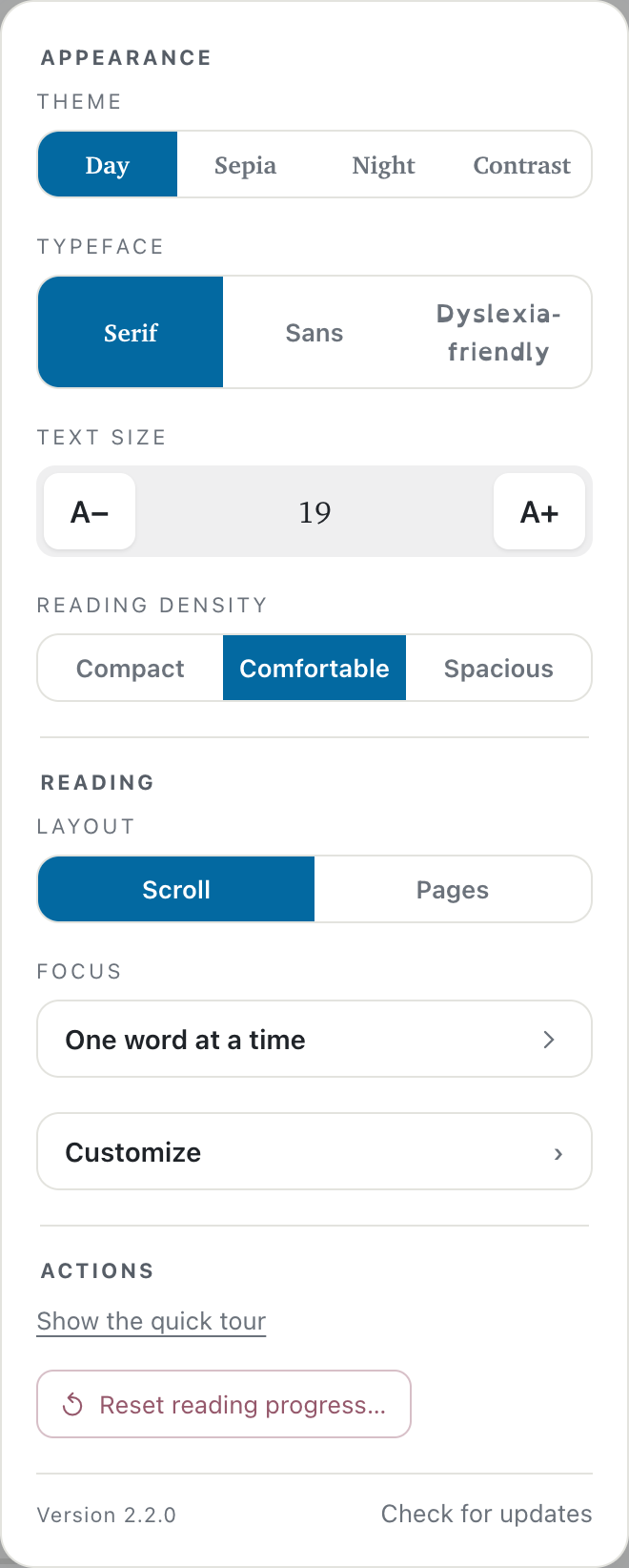
The settings — only the choices that matter up front; the rest tucked behind Customize.
Parts II–IV are drafted and in revision. The largest remaining risk is distributional, not editorial: the writing is moving, but the audience isn't built yet — a book that runs against the cultural default needs readers who have already absorbed the distinctions before it arrives. The free Part I reader is the first move at closing that gap: the sample with a face, something to share before the whole book exists.