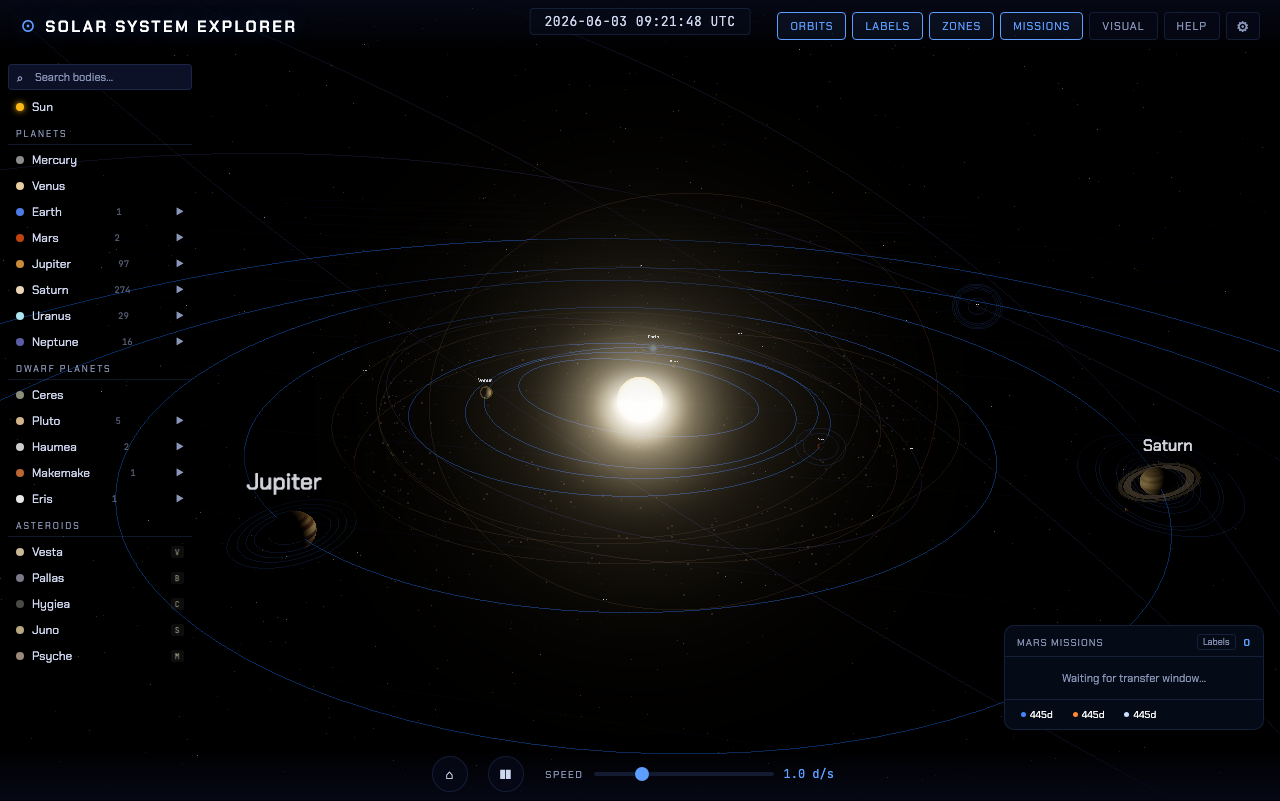
Built with Three.js. The eight planets in their actual orbits, the five IAU-recognised dwarf planets, the major moons of each gas giant, and the named asteroids worth knowing about.
What it does
Click any body in the left panel to focus on it. The camera follows; the orbit fills in. Each planet shows its current moon count — Saturn now at 274 after the IAU confirmed 128 new bodies in March 2025, Jupiter over a hundred and growing, Uranus 28 (with a 29th awaiting confirmation), Neptune 16. Click a planet with moons to expand its list.
Time runs at one day per second by default. Speed it up to watch outer planets crawl through their decades-long orbits in seconds; slow it down for the inner system. The Orbits / Labels / Zones / Missions / Visual toggles in the header turn the overlay layers on and off.
The Mars Missions widget counts down to the next launch window. Earth and Mars line up for a transfer roughly every 26 months on average — the synodic period is around 780 days. Useful if you want to know how long until the next opportunity to send something there.
Asteroids are coded by spectral type — V-type basaltic, B and C-type carbonaceous, S-type stony, M-type metallic. The five named asteroids in the panel (Vesta, Pallas, Hygiea, Juno, Psyche) span those five types neatly.