Two books sit on a shelf at /books/: the Eddas — the Old Norse poems of the gods and heroes, plus Snorri's prose handbook of myth — and Beowulf, the Old English poem. You open one like a real book. The original language is always on the left page; on the right, you choose English, Danish, Norwegian, Swedish, or Icelandic. It is free, and there is nothing to sign up for.
What's new, 21 September
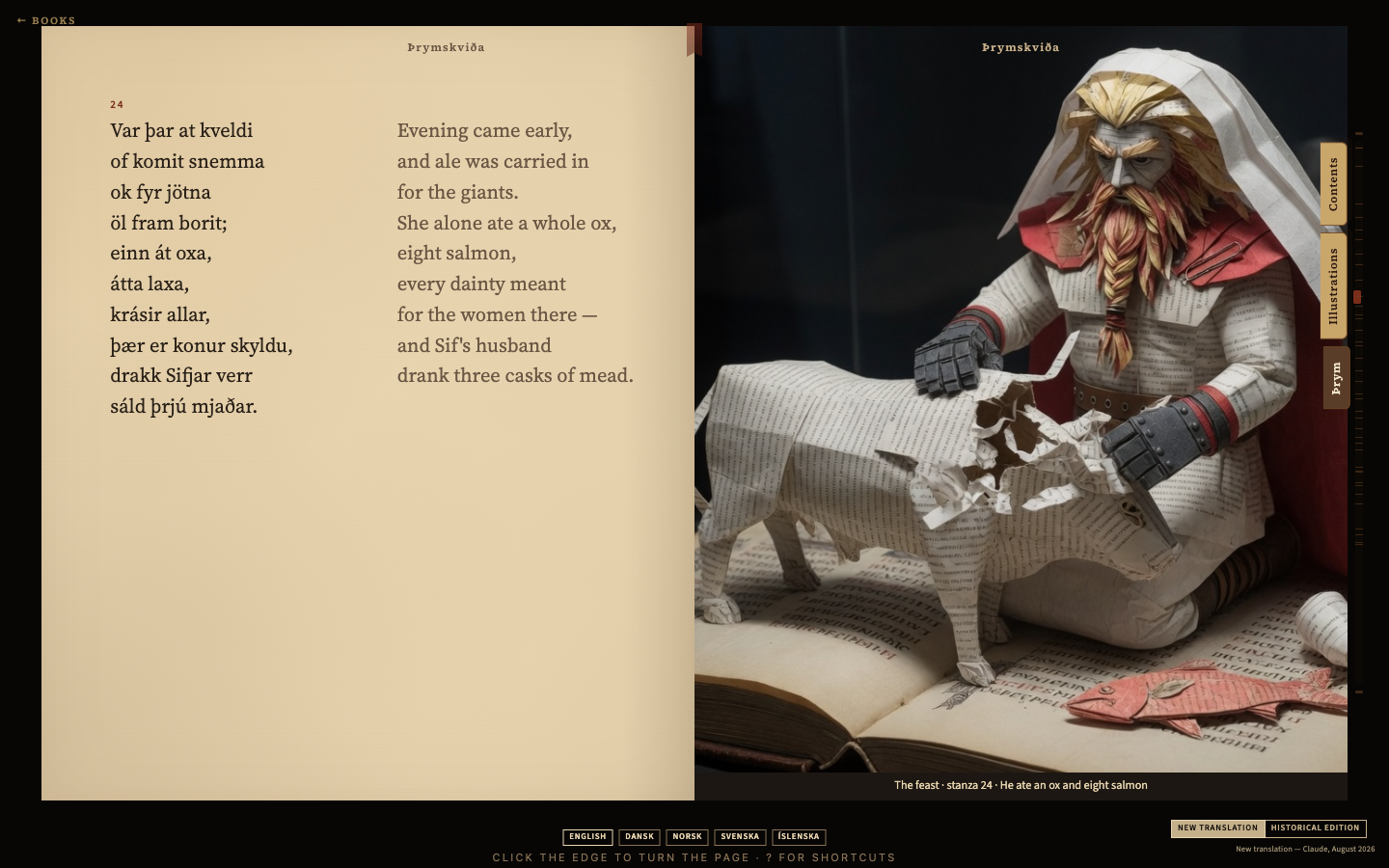
You can send someone a place in the book. The address is the name of the thing: a poem (/edda/#voluspa), a stanza (/edda/#voluspa-3), or a picture (/edda/#thrym-feast, /beowulf/#scyld-ship). Copy the bar while you read and it stays on that spread.
Each picture sits on the right-hand page, next to the verse it belongs to — not on both pages, and not as a poster at the front of the book. The paper is the used-book cream. There is no switch to make it new.
Why I built this
I grew up with these stories, and I wanted to read them the way they deserve to be read — the real text, not a retelling, with a translation honest enough to check. Most of what exists online is either a bare scan of a century-old edition or a modern translation behind a paywall. I wanted the original and a living language on facing pages, in a book that feels like a book, for anyone.
What's actually in it
Every poem of the Poetic Edda — the whole Codex Regius plus the poems that traditionally travel with it — along with Snorri's Prologue and the full Gylfaginning, and Beowulf complete in its 43 fitts. Each text carries two translation layers. The default is a new translation, made in August 2026 with an AI language model, working from the original with the old English-language editions used only as a sense-check. One press switches the whole book to the historical editions — Bellows 1923, Brodeur 1916, Brate 1913, Mortensson-Egnund 1905, Gummere 1909 — reproduced as their editors set them. A line in the corner always names exactly which translation you are reading, and the colophon lays out every source in full.
How the new translations were checked
An AI translation you cannot check is worth little, so checking is most of what this project is. Every text went through an adversarial second pass: an independent checker read every line against the Old Norse or Old English, hunting for errors — wrong actors, dropped negations, invented content, names quietly turned into common words. It found real ones, in every batch, right to the end: a reversed "she" that four languages had inherited together, a rune-charm inverted into its opposite, a royal "we" turned into a literal plural. Each catch was verified against the original and published editions before anything was fixed, and every verdict — including what was flagged and left for a native reader's eye — is recorded in the book's own manifest beside the text it judges.
Read it as a good facing help, not a scholarly edition. The originals and the historical editions carry the authority; the new layer is there to make them readable tonight.
What it is not
It is not a critical edition, and it does not pretend to be one. The scholarly translations — Faulkes for the Eddas, Liuzza for Beowulf — are still in copyright, which is exactly why the historical layer is Bellows and Gummere. Two parts of Snorri's Edda, Skáldskaparmál and Háttatal, are deliberately not in the book yet — parked, not forgotten. And a translation made by a model in 2026 says so on the page, every time, because a translation you cannot trace is a translation you cannot trust.